London Fashion Week September 2026: McQueen Returns, Christopher Kane Debuts at Mulberry
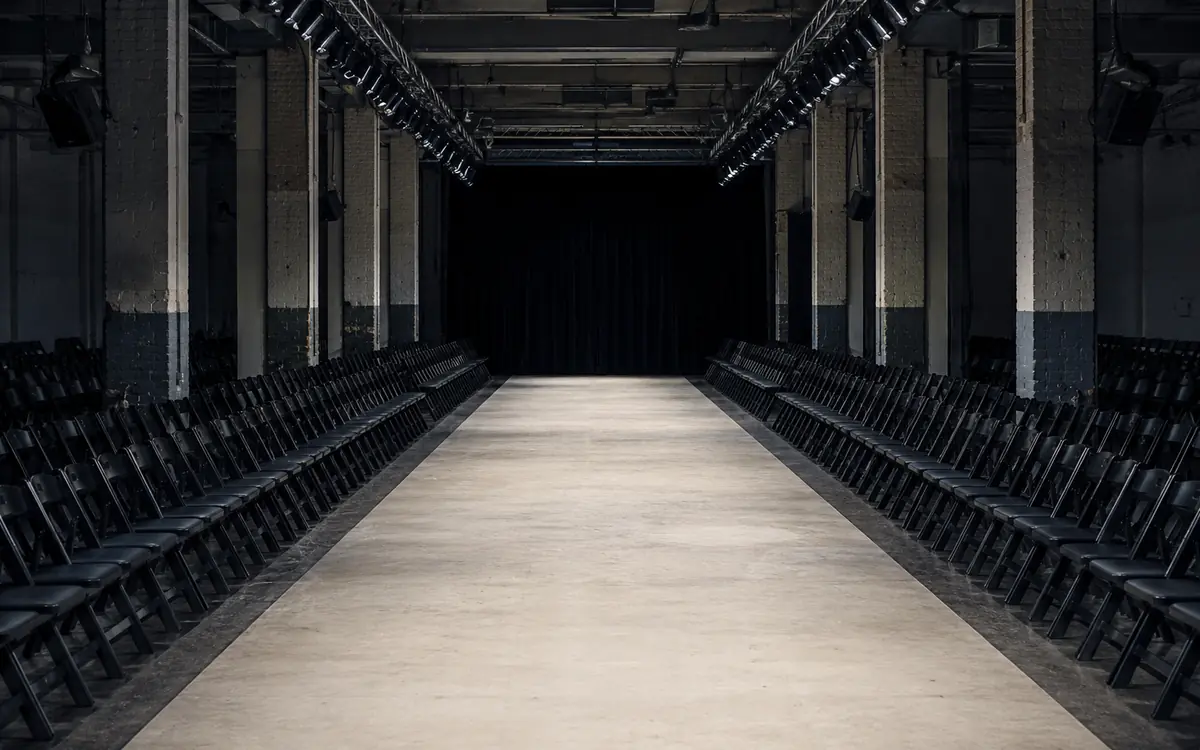
The British Fashion Council has published its provisional schedule for London Fashion Week September 2026, and it is the strongest London line-up in several seasons. The event runs from 17 to 21 September, and two returns dominate it.
McQueen comes home
McQueen is back on the London schedule, with Seán McGirr presenting his London debut for the house — a combined menswear and womenswear Spring/Summer 2027 collection.
The significance here is largely emotional, and London earns it. Alexander McQueen built his reputation in this city, and the house’s shows have been staged in Paris for most of the intervening period. A return to London for McGirr’s first show here is a deliberate piece of stagecraft, and it will draw the international press London has struggled to hold onto in recent seasons.
Christopher Kane at Mulberry
The second headline is arguably the more interesting one commercially. Mulberry returns to the official schedule under new Creative Director Christopher Kane, who will present his debut collection for the brand.
Kane is one of the most distinctive designers Britain has produced this century — a designer whose work has always sat somewhere between the intellectual and the slightly unsettling, and whose own label brought a genuine point of view to London for well over a decade. Mulberry, meanwhile, is a house built on leather goods and a certain kind of English countryside pragmatism.
It is not an obvious pairing, which is what makes it worth watching. The question for September is whether Kane bends towards Mulberry’s heritage or pulls the brand somewhere less comfortable.
The established houses
The rest of the schedule reads like a roll call of British fashion: Burberry, Barbour, Emilia Wickstead, Erdem, Harris Reed, Richard Quinn, Roksanda and Simone Rocha are all confirmed.
That breadth matters. London’s reputation rests on unpredictability, but a schedule made up entirely of emerging talent doesn’t hold international buyers in the city for five days. Having Burberry and Barbour anchoring the week alongside Rocha and Quinn is the balance London has been trying to strike.
New names to watch
Francesca Lake, Gui Rosa and Petra Fagerström will make their London Fashion Week debuts as BFC NEWGEN recipients. Fashion East also returns to the schedule following further BFC investment in the talent support scheme — a meaningful signal, given how much of London’s global reputation over the past twenty years traces back to designers who came through Fashion East and NEWGEN.
Laura Weir, Chief Executive of the British Fashion Council, described the season this way:
This schedule reflects the confidence and momentum of British fashion today, bringing together established houses, emerging designers and industry partners on a platform that continues to shape global fashion.
— Laura Weir, Chief Executive, British Fashion Council
The names that came back
Here is the detail that tells you most about this schedule, and it takes a moment to spot.
A year ago, the September 2025 provisional schedule was conspicuous for who wasn’t on it. JW Anderson, Nensi Dojaka, Chopova Lowena, S.S. Daley, Aaron Esh, Yuhan Wang and Knwls were all absent, and 16Arlington opted out of the main schedule. The reason wasn’t mysterious: showing in London is expensive, and a generation of independent labels had shifted to a season-on, season-off rhythm to survive it.
This September, Aaron Esh, Chopova Lowena and Knwls are all back, listed alongside Ashley Williams and Paolo Carzana.
That’s the clearest evidence yet that the BFC’s interventions under Weir — waiving fees for designers showing physically, expanding the international guest list, putting further money into Fashion East — are having a measurable effect. A schedule is only as strong as the designers who can afford to be on it, and London’s problem for several seasons has been affordability rather than talent.
The retail experiment
The other story of this season is how much of it is aimed at shoppers rather than buyers.
Marks & Spencer joins the official schedule for the first time, with a see-now-buy-now show currently listed for 18 September, marking its centenary. eBay returns with its Endless Runway pre-loved show, shoppable via eBay Live. Selfridges will spotlight participating designers in store. H&M is collaborating with Nick Knight and SHOWstudio on a reinterpretation of the runway format.
Whether you read that as commercial dilution or as sensible modernisation depends largely on your view of what fashion weeks are for. What isn’t in dispute is that London is experimenting more aggressively with the format than Paris, Milan or New York.
Can you watch it? Yes, most of it
The runway shows themselves are trade events. Access is by BFC accreditation, granted to press and buyers, and no amount of enthusiasm will get you a seat at Burberry.
Watching, however, is a different matter, and has been since London went digital in 2020.
The BFC runs a digital schedule at londonfashionweek.co.uk, which carries shows live from the BFC’s own show venue and from selected designers streaming from other locations around the city. It’s free and open to anyone. Alongside the livestreams it hosts fashion films — the format a number of London designers now prefer to a physical show, partly for cost reasons and partly because it gives them control over how the clothes are seen.
Two practical notes. First, most designers also post their show to their own social channels shortly after it premieres, so if you miss the stream you rarely miss the collection. Second, the BFC has recently grouped the digital-only shows together rather than scattering them: in February, all the online shows ran on the final day, roughly one every ten to fifteen minutes across the morning. Whether September repeats that structure isn’t confirmed, but it’s worth checking the digital schedule rather than assuming shows are spread evenly across the five days.
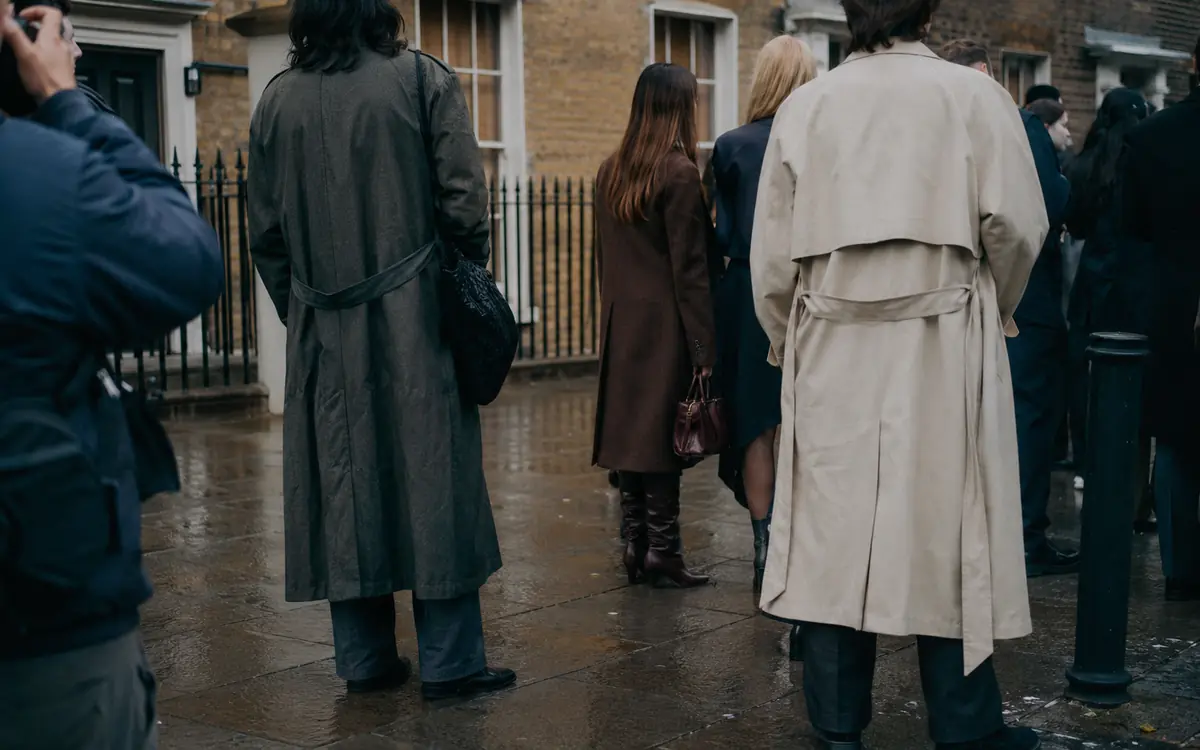
For anyone who wants to be physically present without accreditation, the answer is the street. The pavements outside the main venues are where a substantial part of fashion week actually happens, and nobody has ever needed a pass for that.
What happened last season
If you want a sense of what September might look like, February is the better guide than any preview.
London Fashion Week ran 19–23 February this year — an 11% larger schedule than the previous season, and the first hard evidence that London had stopped shrinking.
The moments that defined it were a mix of the establishment and the genuinely unexpected:
- King Charles attended Tolu Coker’s show on the opening day, where Little Simz performed. He also appeared at the launch of Brand63Africa, a social enterprise connecting designers of African heritage with the global luxury market.
- Joseph returned to the schedule for the first time in almost a decade, showing in an industrial space at Tate Modern.
- Erdem marked its twentieth anniversary at Tate Britain, with Edie Campbell and Karen Elson on the runway and Keira Knightley, Helen Mirren, Glenn Close and Beth Ditto in the front row.
- Simone Rocha announced a collaboration with adidas, previewing parts of it on her own runway — arguably the biggest commercial story of the week.
- Julien Macdonald showed atop the Shard; Chet Lo rebuilt a Hong Kong night market in the ballroom of the Mandarin Oriental; Conner Ives served champagne at Claridge’s with Kim Cattrall watching.
- Burberry closed the week, as it has for over a decade, with Kate Moss in the audience and Rosie Huntington-Whiteley and Romeo Beckham on the runway.
- Heritage names Fiorucci, Ted Baker and Joseph all resurfaced, and Topshop — which didn’t show — still made itself part of the week with a party celebrating its expansion into John Lewis.
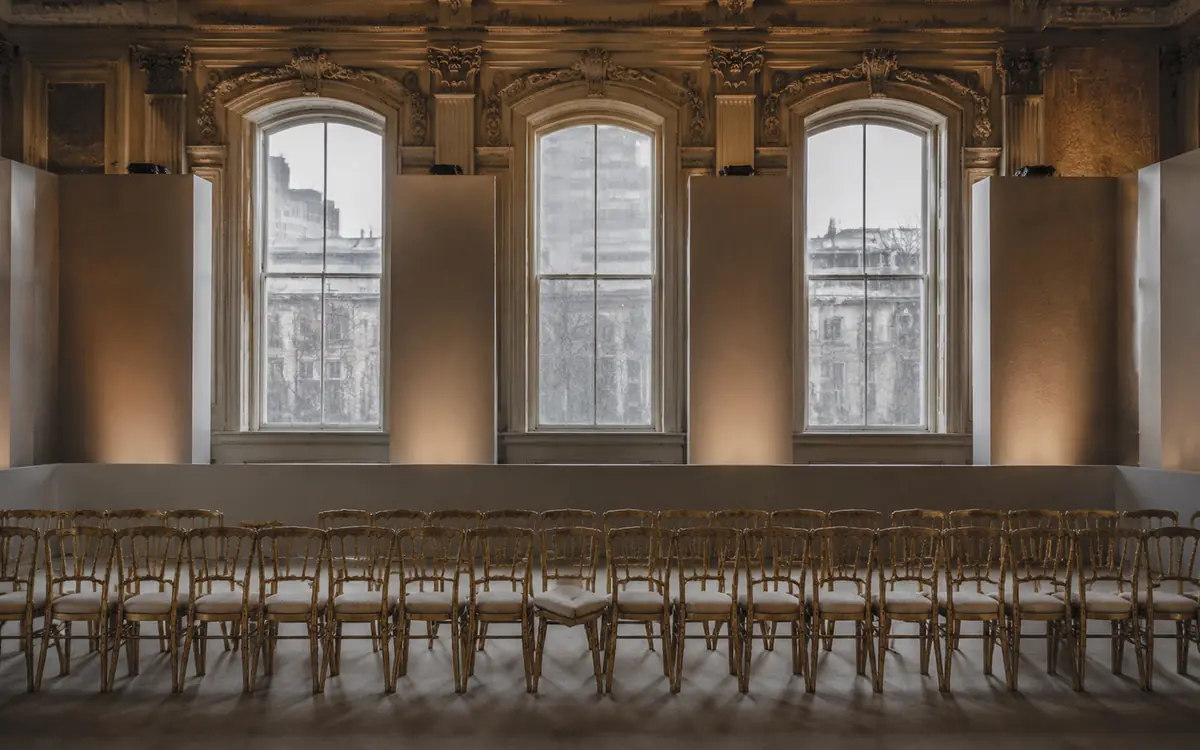
The trends that came out of it were strong shoulders, architectural structure, heavy beading and a restrained tonal palette leaning on off-white.
The relevant point for September is the shape rather than the detail: a schedule that grows, leans on a handful of anchor shows, and increasingly stages itself in museums, hotel ballrooms and rooftops rather than a single central venue.
What to expect this time
Five things are worth watching.
Whether McGirr’s McQueen is a reset or a continuation. This is his London debut for the house and the first time the brand has shown here in years. A combined menswear and womenswear collection gives him room for a statement, and the setting invites one.
Whether Kane’s Mulberry has legs. A debut collection always generates noise. The question is whether it translates into a leather-goods business, which is what Mulberry actually is.
Whether the retail experiment works. M&S, eBay, Selfridges and H&M are all attempting to address shoppers rather than buyers. If it lands, expect other fashion weeks to copy it within a year. If it doesn’t, expect it quietly dropped.
Whether the returning independents stay. Aaron Esh, Chopova Lowena and Knwls being back is good news. Being back again next February would be considerably better news, and is the real test of whether the BFC’s funding changes work.
Whether Burberry closes again. It has for more than a decade, and how the week ends sets the tone of the coverage that follows.
The bottom line
This is a fuller, more confident schedule than London has had in several seasons — two significant houses returning, a batch of independents who could previously not afford to show, and a set of retail experiments nobody else is attempting.
The answers arrive between 17 and 21 September.
London Fashion Week September 2026 runs from 17 to 21 September. The schedule is provisional and subject to change; the BFC publishes the confirmed schedule and the free digital schedule at londonfashionweek.co.uk.