The Autumn Work Dress: One Piece That Solves the Office Wardrobe
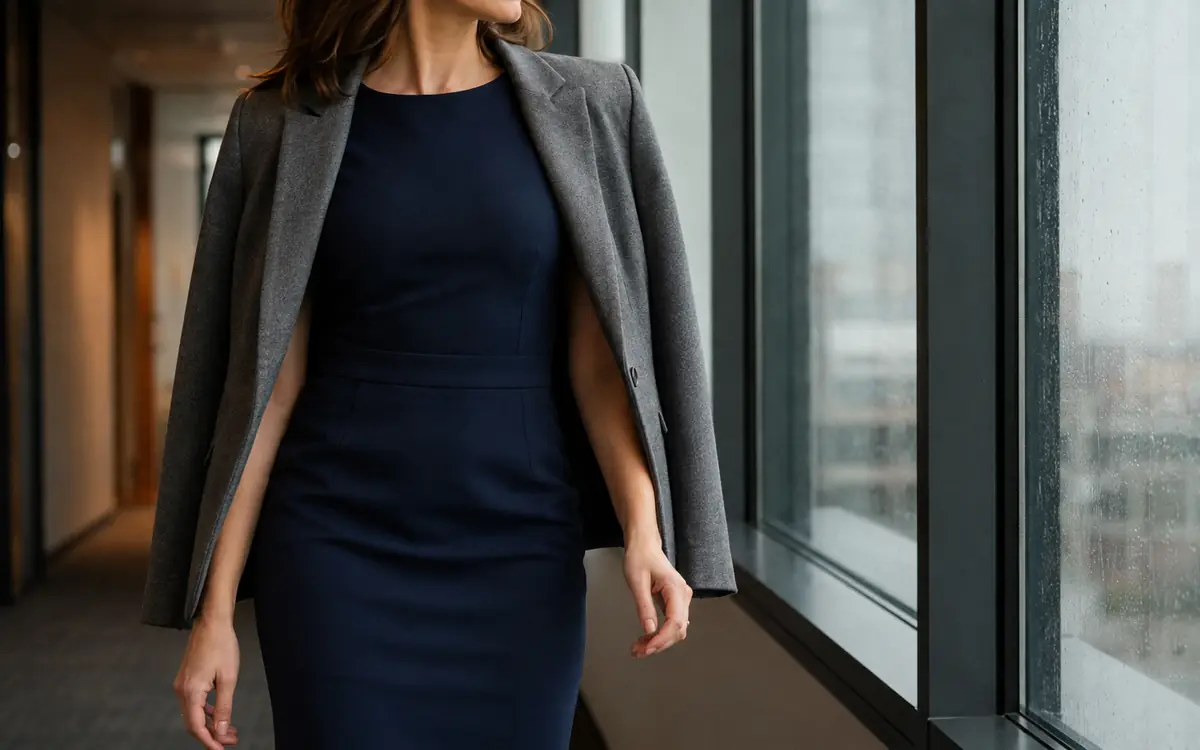
Every September the same problem reappears. The summer wardrobe stops working somewhere around the second week, the office fills up again, and getting dressed on a Tuesday morning becomes a negotiation between three items that don’t quite go together.
The tailored dress is the unglamorous answer, and it’s unfashionable to say so because a dress isn’t a system — it doesn’t offer the endless recombination that separates promise. But that’s precisely its advantage. A good work dress removes the decision entirely. One item, on, done, and it will read as more considered than the trousers and jumper you agonised over.
Why a dress beats separates for work
Three practical reasons, none of them about fashion.
Proportion is solved. The hardest part of separates is getting the relationship between top and bottom right — where the waist sits, where the hem falls, how much shape the whole thing has. A well-cut dress has already answered those questions.
It layers in one direction. A dress takes a blazer, a cardigan, a coat or a knit over the top and stays essentially the same outfit. Separates have to be rebuilt each time.
It survives a long day. A dress in a decent fabric doesn’t untuck, ride up or gape between buttons at four o’clock. This is a genuinely underrated quality.
The cuts that work
The tailored shift. The classic. Clean lines, minimal detail, sits just at or below the knee. It’s the most formal option and the one that takes a blazer best.
The belted midi. More forgiving than a shift and more flattering on most shapes. A defined waist with a skirt that skims rather than clings. If you’re buying one dress, this is usually the one.
The knitted dress. The comfortable option, and considerably smarter than it sounds in a fine-gauge merino. Best in a dark colour with a bit of structure through the body.
The shirt dress. The most casual of the four, and the most versatile across different workplaces. Look for one with a proper collar and a belt rather than a tie fastening, which tends to sag by lunchtime.
What to look for in the fabric
This is where a work dress is made or lost.
- Weight matters more than fibre. A fabric with a bit of substance — ponte, crepe, a fine wool blend, a heavy viscose — will hold its shape through a full day. Anything thin will crease across the lap by mid-morning.
- Check it against the light. Hold the fabric up. If you can see through it, you’ll be layering something underneath every time you wear it, which halves its usefulness.
- Sit down in the fitting room. Then stand up and look at the front. Whatever creases appear in thirty seconds will be there all day.
- Avoid anything requiring dry cleaning weekly. A dress you wear once a week and can’t easily wash is a dress you’ll stop wearing.
Colours for the season
Navy is the strongest choice for a British office — softer than black, easier to accessorise, and now the default dark neutral in most wardrobes. Beyond that, chocolate brown and burgundy are both having a moment and both look considerably more expensive than black in a good fabric. Bottle green is the quietly interesting option if you want something less predictable.
Black is fine. It’s just the least interesting version of the same dress.
Making one dress look like five
The whole point is that the layering does the work.
- Monday: dress with a tailored blazer and a loafer.
- Tuesday: the same dress with a fine knit pulled over the top, so only the skirt shows — it reads as a two-piece.
- Wednesday: dress with a knitted vest over it, collar of a shirt showing underneath.
- Thursday: dress with opaque tights and a tall brown boot.
- Friday: dress with a denim or suede jacket and a trainer.
Five outfits, one dress, five minutes of thought across the entire week.
Where to shop
Hobbs remains the reference point for tailored British dresses, and its fabric quality in the mid-price bracket is consistently better than the high street’s. Whistles is the slightly sharper, more contemporary sibling — both now sit under the same ownership, which increasingly means shared floor space. Marks & Spencer’s Autograph line has improved sharply and is where to look if budget matters. Arket and COS handle the minimalist end well, and Mango is worth checking for the fashion-led shapes if you don’t need it to last five years.
The verdict
Buy one dress that fits properly in a fabric with weight, in navy or chocolate, and hang it at the front of the wardrobe. It will get you through the entire autumn with less thought and better results than anything else you own — which is, in September, exactly what’s needed.